A dying car battery rarely quits in July. In Dallas, it usually quits on the first cold morning in November or December, right when you have somewhere to be. The damage, though, was done months earlier by the summer heat. This guide explains why Dallas batteries fail the way they do, the seven warning signs to watch for, what to do if your car won’t start, and how to get a free battery test at Pit Pros before the next cold front.
Why Dallas Heat Kills Car Batteries
Most people think cold weather kills batteries. Cold is what exposes the problem. Heat is what causes it.
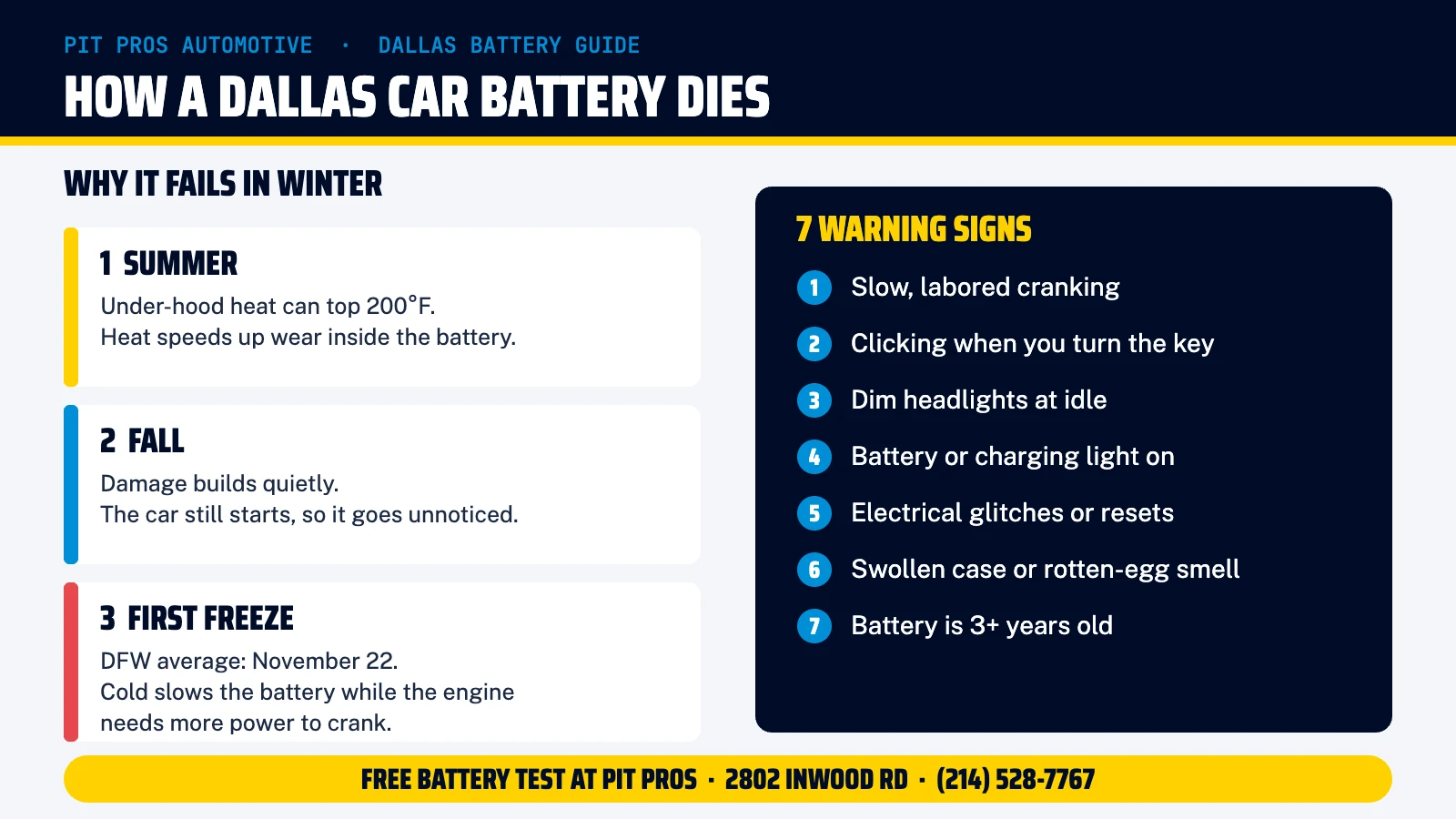
According to AAA, temperatures under the hood can top 200°F in hot weather, and heat speeds up the wear inside a battery. That is why AAA says batteries in cooler northern climates may last five years or longer, while in southern states about three years is more typical.
Think about a normal Dallas summer: weeks of triple-digit afternoons, cars parked in open lots, engines idling in traffic on I-35E and the Tollway with the A/C on full. Every one of those days takes a little life out of the battery. You don’t notice, because a warm engine is easy to start.
Why the First Cold Snap Finishes the Job
Cold weather slows the chemical reaction that makes a battery produce power. At the same time, cold engine oil is thicker, so the starter needs more power to turn the engine over. A healthy battery handles that. A battery that lost strength over the summer may not.
In Dallas–Fort Worth, the average first freeze arrives around November 22, according to the National Weather Service. That is why shops across North Texas see a wave of no-start calls in late November and December. The car was fine on Friday. Saturday morning is 30°F, and all you hear is a click.
Short trips make it worse
If most of your driving is a few miles to work, school or the store, the alternator may not have time to fully recharge the battery after each start. Cars that sit for days at a time also slowly lose charge. Both habits are common in the city, and both shorten battery life.
7 Warning Signs of a Dying Car Battery
A battery usually gives you some warning before it leaves you stranded. Watch for these signs:
- Slow, labored cranking. The engine turns over more slowly than usual, especially on cool mornings.
- Clicking when you turn the key or press start. A rapid click with no crank often means the battery can’t deliver enough power, or a connection is loose or corroded.
- Dim headlights at idle. Lights that brighten when you rev the engine point to a weak battery or a charging problem.
- Battery or charging warning light. This light can mean a problem with the battery, the alternator or the wiring between them.
- Electrical glitches. The radio resets, the clock loses time, power windows move slowly, or the dash flickers.
- A swollen case or a rotten-egg smell. A bulging battery or a sulfur smell can signal overheating or internal damage. Don’t ignore either one.
- Age. If your battery is three years old or more, it is in the window where Texas batteries commonly fail, even with no symptoms.
Not every dying car battery shows a clear warning. Some work fine one day and are dead the next. That is why a test is the only way to know for sure.
What to Do If Your Car Won’t Start
- Check the basics. Make sure the car is in Park, and that the lights or accessories weren’t left on overnight.
- Look at the battery terminals. White or green crust on the posts can block power. Don’t touch the terminals with bare hands.
- Get a jump start, carefully. Follow the steps in your owner’s manual. Some newer cars have specific jump points under the hood.
- Drive straight to a shop. A jump start gets you moving, but it doesn’t fix a weak battery. If the car needed a jump once, it will likely need one again on the next cold morning.
- Get the battery tested before you replace it. A no-start can also come from a failing alternator, a bad starter, or a loose cable. Testing first means you don’t pay for a battery you didn’t need.
How Long Does a Car Battery Last in Texas?
Nationally, most car batteries last three to five years. In Texas heat, plan on the shorter end, around three years. AAA recommends testing your battery every year once it is three years old. Check the date sticker on top of your battery, or look in your service records. If you can’t find a date, it is a good reason to have it tested.
A few habits help a battery last longer:
- Park in a garage or shade when you can during the summer.
- Keep the terminals clean and the hold-down clamp tight, since vibration also wears batteries out.
- Take a longer drive now and then if most of your trips are short.
- Have the battery checked during regular maintenance, not only when it fails.
Free Battery Test at Pit Pros Automotive
Bring your car to our shop at 2802 Inwood Rd and we will test your battery for free. It takes the guesswork out: you will know whether your battery is healthy or getting weak before the next cold front shows you the hard way.
If your battery does need to be replaced, you get a written estimate first, and nothing is replaced or repaired without your approval. Battery testing and replacement are part of our preventative maintenance service, so we can look at the rest of the car while it is here if you want us to.
Busy during the day? Use our key drop box to drop your car off anytime, before or after hours. Call (214) 528-7767 with questions about battery pricing for your vehicle.
Why Dallas Drivers Trust Pit Pros
Pit Pros Automotive has been family-owned since 1986 and is a 6× CARFAX Top-Rated Service Center, 2020–2025. We are at 2802 Inwood Rd, minutes from Love Field, and serve drivers across Dallas.
- Hours: Monday to Friday, 8:00 AM to 6:00 PM, and Saturday, 8:00 AM to 3:00 PM. Closed Sunday.
- Anytime drop-off: Use the key drop box before or after hours.
- No surprises: Written estimate first, and nothing is repaired without your approval.
Heading out of town for the holidays? Pair your battery test with our road trip car check guide. And since the state no longer inspects brakes, tires or lights, our post on preventive maintenance inspections explains what else is worth checking before winter. To schedule your free battery test, call (214) 528-7767 or contact us online.