When the check engine light comes on, most drivers ask the same three questions: Is it serious? Can I keep driving? And will it keep me from renewing my registration? This guide answers all three in plain language, from a Dallas shop that has been reading these lights since they were invented.
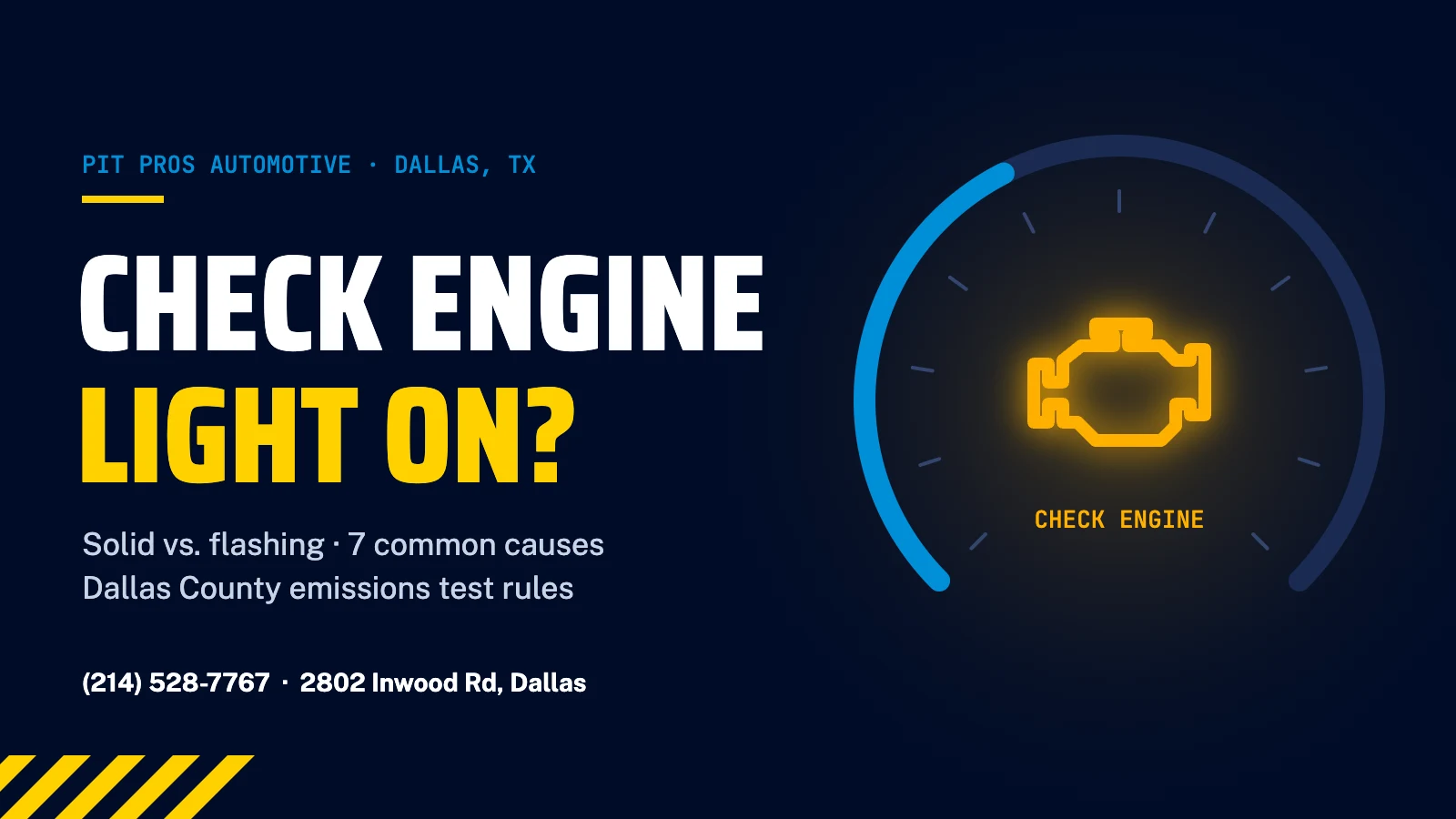
Here is the short version. A solid check engine light means your car’s computer found a problem and you should get it checked soon. A flashing check engine light means a problem is happening right now that can damage the engine or catalytic converter, so ease off and get it looked at today. And in Dallas County, any check engine light that is on is an automatic fail on the emissions test.
At Pit Pros Automotive on Inwood Road, we have helped Dallas drivers since 1986. Below are the seven most common causes we see, what each one costs you if you wait, and exactly what to do next.
What the Check Engine Light Actually Means
Every car and light truck sold in the U.S. since 1996 has an onboard diagnostic system, called OBD-II. It constantly watches the engine, fuel system, ignition and emissions equipment. When a reading falls outside the normal range, the computer stores a trouble code (for example, P0420) and turns on the check engine light.
The light does not tell you what is broken. It tells you the computer saw something it did not like. One code can have several possible causes, which is why the code is the starting point of a diagnosis, not the answer.
Solid vs. Flashing Check Engine Light
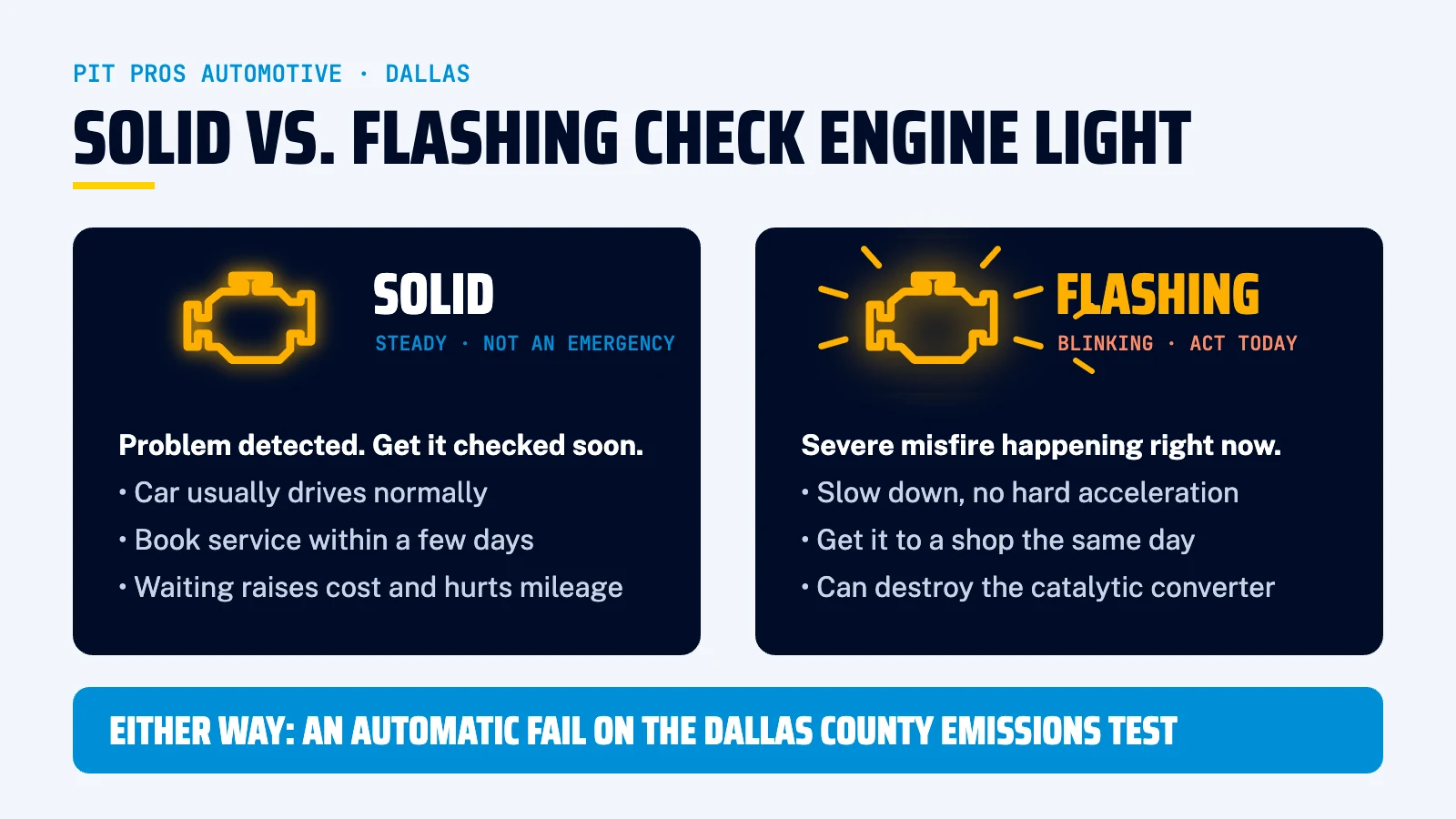
Solid (steady) light: The problem is real but usually not an emergency. The car may drive normally. Book an appointment in the next few days. Waiting weeks lets a small, cheap repair turn into a bigger one and hurts fuel mileage in the meantime.
Flashing (blinking) light: This almost always means a severe engine misfire. Unburned fuel is going into the exhaust, where it can overheat and destroy the catalytic converter. Reduce speed, avoid hard acceleration and towing, and get the car to a shop the same day. If the car is shaking hard, losing power or you smell fuel, pull over safely and call for a tow.
Light plus a red warning: If the check engine light comes on together with a high temperature gauge, red oil pressure light or red battery light, stop driving. Those are the warnings that protect the engine itself.
7 Common Causes of a Check Engine Light
1. A Loose or Worn Gas Cap
The fuel system is sealed so gasoline vapor does not escape. A cap that is loose, cross-threaded or has a cracked seal lets vapor out, and the computer sets an evaporative leak code. Tighten the cap until it clicks. If that was the problem, the light usually goes off on its own after several days of driving. If it comes back, the cap or another part of the vapor system needs attention.
2. A Failing Oxygen Sensor
Oxygen sensors measure how much unburned oxygen is in the exhaust so the computer can set the right fuel mixture. They wear out with age and mileage. A bad sensor can cost you real money at the pump and, left alone long enough, can contribute to catalytic converter damage.
3. Worn Spark Plugs or Ignition Coils (Misfire)
Misfires are the most common reason for a flashing check engine light. Worn spark plugs, a failing ignition coil or a clogged fuel injector keeps one cylinder from firing. You may feel a stumble, rough idle or hesitation. Caught early, this is usually a plug or coil. Ignored, it can take the catalytic converter with it.
4. Catalytic Converter Efficiency
The catalytic converter cleans the exhaust. A code like P0420 means it is not doing that job as well as it should. Converters rarely fail on their own; they are usually damaged by an earlier problem such as misfires, oil burning or a bad oxygen sensor. A replacement often runs well over $1,000, so finding and fixing the root cause first matters. Otherwise the new converter fails too.
5. Mass Airflow (MAF) Sensor Problems
The mass airflow sensor tells the computer how much air is entering the engine. When it gets dirty or fails, the fuel mixture is off. Symptoms include hesitation, rough idle, stalling and poor mileage. Sometimes cleaning fixes it; sometimes it needs replacing. A proper test tells you which, before you spend money on parts.
6. Evaporative (EVAP) System Leaks
Beyond the gas cap, the EVAP system has hoses, valves and a charcoal canister that can crack or stick, especially after years of Texas heat. These leaks rarely affect how the car drives, but they will keep the check engine light on and will fail the emissions test. Finding small vapor leaks takes a smoke test, not just a code reader.
7. Battery and Charging System Issues
Dallas summers are hard on batteries. A weak battery or failing alternator causes low system voltage, which can set codes and make other systems act strangely. If your check engine light showed up along with slow cranking or flickering lights, have the battery and charging system tested at the same visit.
Can You Pass the Dallas County Emissions Test With the Check Engine Light On?
No. Texas ended the annual safety inspection for personal vehicles on January 1, 2025 (House Bill 3297), and drivers now pay a $7.50 inspection program replacement fee at registration instead. But Dallas County is still an emissions county. Gasoline vehicles from 2 to 24 years old must pass an emissions test before you can renew your registration.
That test plugs into the OBD-II port. If the check engine light is on, the car fails. Period. Read more about the current rules in our Texas inspection guide.
Do not just clear the code before the test. Erasing codes turns the light off, but it also resets the car’s readiness monitors to “not ready.” According to the Texas Department of Public Safety, vehicles from 2001 and newer can have only one monitor “not ready” and still pass; 1996 to 2000 models can have two. Disconnecting the battery causes the same reset. The fix is to repair the actual problem, then drive normally for a few days of mixed city and highway driving so the monitors complete before you test.
Can You Keep Driving With the Check Engine Light On?
With a solid light and a car that drives normally, you can usually keep driving for a short time while you schedule service. Watch the gauges and pay attention to new noises, smells or changes in how it runs.
With a flashing light, keep driving to a minimum. Every mile with a severe misfire raises the odds of a damaged catalytic converter, which turns a modest repair into an expensive one. If you can, drop the car off rather than driving it around for days.
Why a Free Code Read Is Not a Diagnosis
Parts stores will read your code for free, and that can be a useful first look. But a code like P0171 (system too lean) can come from a vacuum leak, a dirty sensor, a weak fuel pump or a clogged injector. Guess wrong and you buy parts you did not need, and the light comes right back.
A real diagnosis means reading the code, checking live sensor data, testing the suspect parts and confirming the fix. That is what our engine diagnostics service does. You get a clear answer, a written estimate and nothing gets repaired until you approve it.
What to Do When Your Check Engine Light Comes On
- Check if it is solid or flashing. Flashing means slow down and get it in today.
- Look at your other gauges. Red temperature, oil or battery warnings mean stop driving.
- Tighten the gas cap until it clicks, especially if you just filled up.
- Note any symptoms: rough idle, hesitation, smells, noises, worse fuel mileage. These help us find the problem faster.
- Do not clear the code to get through an emissions test. It will not work and it erases information we use to diagnose.
- Book a diagnosis before a small repair becomes a big one. Staying on top of routine service also prevents many of these codes in the first place.
Check Engine Light Help in Dallas at Pit Pros Automotive
Pit Pros Automotive is a family-owned shop at 2802 Inwood Rd, Dallas, TX 75235, minutes from Love Field and the Medical District. We are a 6× CARFAX Top-Rated Service Center, 2020–2025. We diagnose the check engine light, explain what we found in plain English, fix it once you approve, and handle your Dallas County emissions test under the same roof.
Short on time? Use our key drop box and drop your car off any time, even before or after work. We are open Monday to Friday, 8:00 AM to 6:00 PM, and Saturday, 8:00 AM to 3:00 PM. Call (214) 528-7767 or book your service online.